Kerry Blue Terrier
Standard
General Appearance
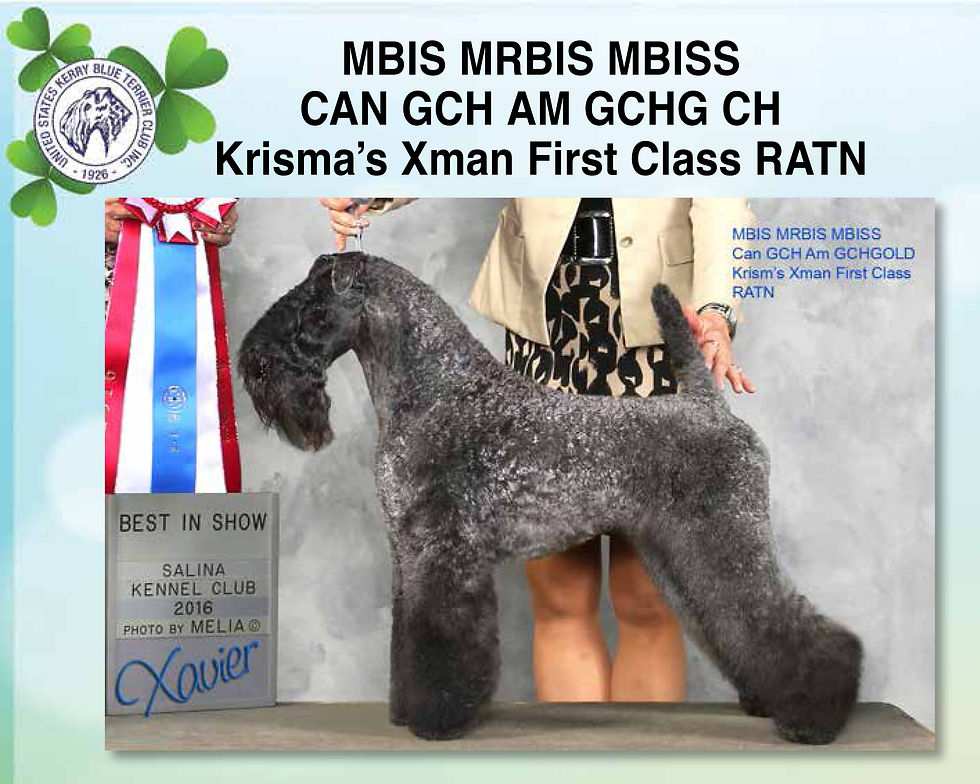
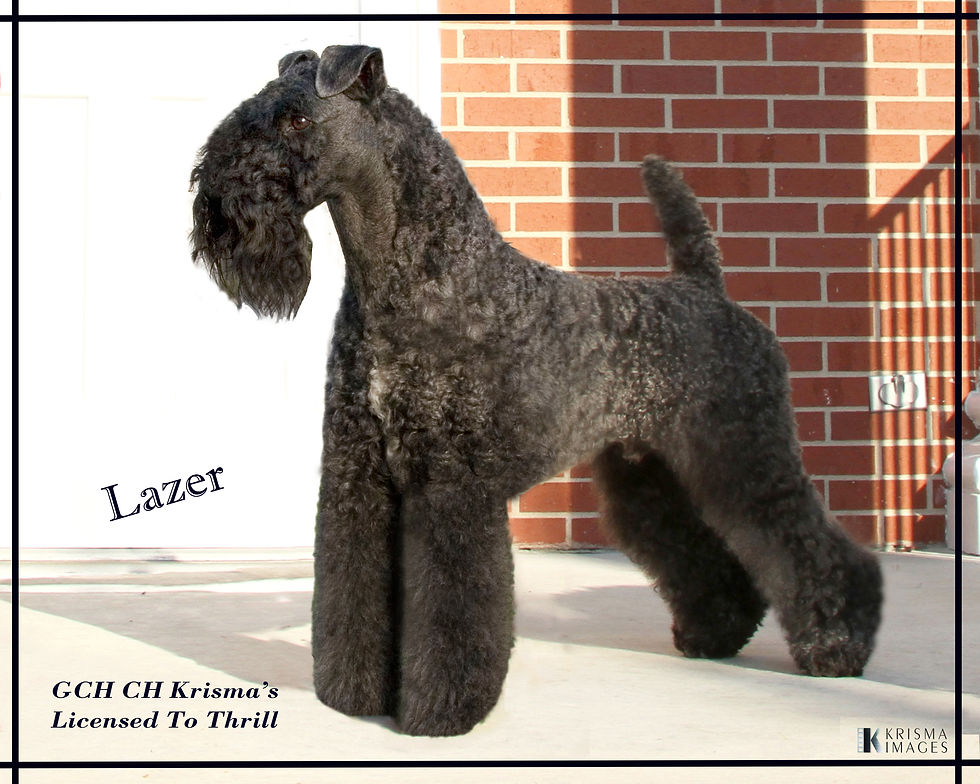
The typical Kerry Blue Terrier should be upstanding well knit and in good balance, showing a well-developed and muscular body with definite terrier style and character throughout. Correct coat and color are important. A low-slung Kerry is not typical.
By the USKBTC
Size, Proportion, Substance
The ideal Kerry should be 18 1/2" at the withers for a dog, slightly less for a bitch. In judging Kerries, a height of 18"-19 1/2" for a dog, and 17 1/2" - 19" for a bitch, should be given primary preference.
Only where the comparative superiority of a specimen outside of the ranges noted clearly justifies it should greater latitude be taken. In no case it extends to a dog over 20" or under 17 1/2", or to a bitch over 19 1/2 " or under 17".
The minimum limits do not apply to puppies. The most desirable weight for a fully developed dog is from 33-40 pounds, bitches weighing proportionately less. A well-developed and muscular body. Legs moderately long with plenty of bone and muscle.
Head
Long, but not exaggerated, and in good proportion to the rest of the body. Well balanced. Eyes- dark, small, not prominent, well placed with a keen terrier expression. Anything approaching a yellow eye is very undesirable.
Ears V-shaped, small but not out of proportion to the size of the dog, of moderate thickness, carried forward close to the cheeks with the top of the folded ear slightly above the level of the skull. A "dead" ear, houndlike in appearance is very undesirable.
Skull- flat, with very slight stop, of but moderate breadth between the ears, and narrowing very slightly to the eyes. Foreface full and well made up, not falling away appreciably below the eyes but moderately chiseled out to relieve the foreface from wedginess. Little apparent difference between the length of the skull and foreface. Jaws deep, strong and muscular. Cheeks- clean and level, free from bumpiness.
Nose- black, nostrils large and wide. Teeth - strong, white and either level or with the upper (incisors) teeth slightly overlapping the lower teeth. An undershot mouth should be strictly penalized.


Neck, Topline, Body
Neck- clean and moderately long, gradually widening to the shoulders upon which it should be well set and carried proudly.
Back short, strong and straight (i.e. level ) with no appearance of slackness. Chest deep and of moderate breadth. Ribs fairly well sprung,, deep rather than round.
A slight tuck-up. Loin short and powerful. Tail should be set on high, of moderate length and carried gaily erect, the straighter the tail the better.
Forequarters
Shoulders fine, long and sloping, well laid back and well knit. The elbows hanging perpendicularly to the body and working clear of the side in movement.
The forelegs should be straight from both front and side view. The pasterns short, straight and hardly noticeable.
Feet should be strong, compact fairly round and moderately small, with good depth of pad free from cracks, the toes arched, turned neither in nor out with black toenails.


Hindquarters
Strong and muscular with full freedom of action, free from droop or crouch, the thighs long and powerful, stifles well bent and turned neither in nor out, hocks near the ground and when viewed from behind upright and parallel with each other, the dog standing well up on them.
Coat
Correct coat is important. It is to be soft, dense and wavy. A harsh, wire or bristle coat should be severely penalized. In show trim the body should be well covered but tidy, with the head ( except for the whiskers ), ears and cheeks clear.
Color
Color is important. The correct mature color is any shade of blue gray or gray blue from the deep slate to light blue gray, of a fairly uniform color throughout except that distinctly darker to black parts may appear on the muzzle, head, ears tail and feet. Kerry color in its process of "clearing" changes from an apparent black at birth to the mature gray blue or blue gray.
The color passes through one or more transitions - involving a very dark blue ( darker than deep slate ) shades or tinges of brown and mixtures of these together with a progressive infiltration of the correct mature color. The time needed for this "clearing" process varies with each dog.
Small white markings are permissible. Black on the muzzle, head, ears, tail and feet is permissible at any age. A black dog 18 months of age or older is never permissible in the show ring and is to be disqualified.
Disqualifications
A black dog 18 months of age or older is to be disqualified. (white markings on a black dog 18 months of age or older does not constitute clearing or mature color and the dog is to be disqualified. )


Gait
Full freedom of action. The elbows hanging perpendicularly to the body and working clear of the sides in movement; both forelegs and hind legs should move straight forward when traveling, the stifles turning neither in nor out.
Written by the United States Kerry Blue Terrier Club Effective January 1, 2006
Side Note
A standard is written for every breed by the parent club. Breeders strive to breed for these characteristics. Judges are to judge each dog in the ring against the standard to find the dog that best meets the criteria on that day. However, as you can see it is open to interpretation, opinions and styles vary within every breed. Physically each dog must be able to perform the duties they were breed to do.